
So, if anyone is interested in some seriously well done exploration on Catholic social teaching in the context of the rights of labor, hie thee to the current issue of The Journal of Catholic Legal Studies. Now, admittedly, I'm prejudiced, as my article “Not Charity But Justice”: Charles Gore, Workers, and the Way, which deals with parallel Anglican developments around the time of Rerum Novarum, appears as one of the articles, based on a presentation I gave at the conference recorded in this double issue. But, quite seriously, the bishops, theologians and lay presenters exemplified what to me was best in my Catholic upbringing. It was a trip back to a place no longer my home, but one which played a powerful role in forming who I am.
And, one last taste of Benjamin Britten, to end April with:
Monday, April 30, 2012

Sunday, April 29, 2012
For I Will Consider My Cat Gilesy
Every year at St. Barts we have Morning Prayer as the main service on three Sundays. When we do this in Eastertide, it's normally accompanied by Benjamin Britten's "Rejoice in the Lamb," as the anthems throughout the service. Needless to say, in our heavily catted home, the section in which the poet Christopher Smart considers his cat Jeoffry is a favorite:
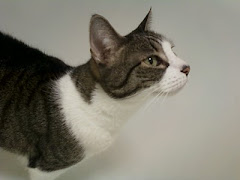
So, in the spirit of this, let me consider my cat Giles, who was, when I first met him, a feral on Long Island.
For he came into my home in a blizzard, bringing in three kittens;
And who is gentle to the weaker cats, protecting them against bullying;
and who is affectionate with me, trusting me to pet him despite never having been tamed;
and who the vet calls simply, the Gentle Cat.
Who is ten years old this year, and nine years in my house.
For which I rejoice.
Oh, and La Caterina noted when the soloist began "For the mouse is a creature of great personal valor," "they sure are if they come in our house."

For I will consider my Cat Jeoffry.Now, only some of this was put to music by Benjamin Britten, but here it is:
For he is the servant of the Living God duly and daily serving him.
For at the first glance of the glory of God in the East he worships in his way.
For is this done by wreathing his body seven times round with elegant quickness.
For then he leaps up to catch the musk, which is the blessing of God upon his prayer.
For he rolls upon prank to work it in.
For having done duty and received blessing he begins to consider himself.
For this he performs in ten degrees.
For first he looks upon his fore-paws to see if they are clean.
For secondly he kicks up behind to clear away there.
For thirdly he works it upon stretch with the fore paws extended.
For fourthly he sharpens his paws by wood.
For fifthly he washes himself.
For Sixthly he rolls upon wash.
For Seventhly he fleas himself, that he may not be interrupted upon the beat.
For Eighthly he rubs himself against a post.
For Ninthly he looks up for his instructions.
For Tenthly he goes in quest of food.
For having consider'd God and himself he will consider his neighbour.
For if he meets another cat he will kiss her in kindness.
For when he takes his prey he plays with it to give it chance.
For one mouse in seven escapes by his dallying.
For when his day's work is done his business more properly begins.
For he keeps the Lord's watch in the night against the adversary.
For he counteracts the powers of darkness by his electrical skin and glaring eyes.
For he counteracts the Devil, who is death, by brisking about the life
For in his morning orisons he loves the sun and the sun loves him.
For he is of the tribe of Tiger.
For the Cherub Cat is a term of the Angel Tiger.
For he has the subtlety and hissing of a serpent, which in goodness he suppresses.
For he will not do destruction, if he is well-fed, neither will he spit without provocation.
For he purrs in thankfulness, when God tells him he's a good Cat.
For he is an instrument for the children to learn benevolence upon.
For every house is incompleat without him and a blessing is lacking in the spirit.
For the Lord commanded Moses concerning the cats at the departure of the Children of Israel from Egypt.
For every family had one cat at least in the bag.
For the English Cats are the best in Europe.
For he is the cleanest in the use of his fore-paws of any quadrupede.
For the dexterity of his defence is an instance of the love of God to him exceedingly.
For he is the quickest to his mark of any creature.
For he is tenacious of his point.
For he is a mixture of gravity and waggery.
For he knows that God is his Saviour.
For there is nothing sweeter than his peace when at rest.
For there is nothing brisker than his life when in motion.
For he is of the Lord's poor and so indeed is he called by benevolence perpetually -- Poor Jeoffry! poor Jeoffry! the rat has bit thy throat.
For I bless the name of the Lord Jesus that Jeoffry is better.
For the divine spirit comes about his body to sustain it in compleat cat.
For his tongue is exceeding pure so that it has in purity what it wants in musick.
For he is docile and can learn certain things.
For he can set up with gravity which is patience upon approbation.
For he can fetch and carry, which is patience in employment.
For he can jump over a stick which is patience upon proof positive.
For he can spraggle upon waggle at the word of command.
For he can jump from an eminence into his master's bosom.
For he can catch the cork and toss it again.
For he is hated by the hypocrite and miser.
For the former is affraid of detection.
For the latter refuses the charge.
For he camels his back to bear the first notion of business.
For he is good to think on, if a man would express himself neatly.
For he made a great figure in Egypt for his signal services.
For he killed the Icneumon-rat very pernicious by land.
For his ears are so acute that they sting again.
For from this proceeds the passing quickness of his attention.
For by stroaking of him I have found out electricity.
For I perceived God's light about him both wax and fire.
For the Electrical fire is the spiritual substance, which God sends from heaven to sustain the bodies both of man and beast.
For God has blessed him in the variety of his movements.
For, tho he cannot fly, he is an excellent clamberer.
For his motions upon the face of the earth are more than any other quadrupede.
For he can tread to all the measures upon the musick.
For he can swim for life.
For he can creep.
So, in the spirit of this, let me consider my cat Giles, who was, when I first met him, a feral on Long Island.
For he came into my home in a blizzard, bringing in three kittens;
And who is gentle to the weaker cats, protecting them against bullying;
and who is affectionate with me, trusting me to pet him despite never having been tamed;
and who the vet calls simply, the Gentle Cat.
Who is ten years old this year, and nine years in my house.
For which I rejoice.
Oh, and La Caterina noted when the soloist began "For the mouse is a creature of great personal valor," "they sure are if they come in our house."

Saturday, April 28, 2012
Why Not Just Download the Text?
So, on my way home from a wedding tonight, I walked passed some book dealers up by my old alma mater, and stopped in a bookshop I've visited from time to time over the years (Westsider books, to be precise. They have some very nice things, reasonable prices, and friendly staff. Drop in, if you're in the area.) Just as I was leaving, I spotted, in the "signed books" section, a copy of Robertson Davies's The Lyre of Orpheus. "Signed?," I thought, "pfui; I don't believe it." I picked it up, turned it over. Good shape, nice dust jacket. Someone highsmithed it already. Nice. I opened it. First American Trade Edition, it read on the copyright page. But--I have one. Oh, a little bit more worn, but still...So I turned the page. And, whaddaya know:

Now, I met Dr. Davies once, near the end of his life, on a reading tour for his last novel, The Cunning Man. I didn't get that book signed because I had a first Canadian, and Davies did not sign books at the reading; one bought copies afterward that he had already signed. When I got to shake his hand, he was affable, and kind, to a fan (his wife Brenda was even more gracious), and I immediately regretted not buying a signed copy at the reading. Years later, a replay was offered me.
Reader, I grabbed it. A subsequent review on Abeooks convinced me that I had done tolerably well as to price; not the lowest price for this book signed by RD in this condition, but well within the range, with a fair number going for more than I paid and a few below.
So why? La Caterina, who does not get fannish behavior at all, was not harsh, but in view of the fact that this is simply a better copy of a book I already had, it seemed, well, silly to her. No doubt it is. But books are to me much more then their contents. Don't get me wrong, I appreciate the Kindle, the iPad, all the ways of getting a lot more to read and enjoy. But for the stuff I love, a connection with the author--seeing it the way he or she did when it came off the press, or owning, in the case of a great writer like Davies, a copy he's signed with his fountain pen, and the laboriously learned dramatic signature he acquired in mid life (seriously, Judith Skelton Grant's bio is a treasure trove), I want the "real thing." The one that doesn't need to recharge. That's tactile. That's, well, and here I make common cause with Rupert Giles, smelly:
Giles says the problem with computers is that that they don’t smell. He goes on to say how smell is a powerful trigger to memory. “Books smell musty, rich,” he says, “knowledge gained from the computer has no texture, no context.” He closes his arguments with, “the getting of knowledge should be tangible… smelly.”Yeah.
Monday, April 23, 2012
A Little Night Music
Nothing to report today, but a good night for the Civil Wars:
And here's a song written and performed by a dear friend, a few years ago...
And here's a song written and performed by a dear friend, a few years ago...
Sunday, April 22, 2012
Follow Up: SNAP Deposition Round 2
In the absence of a written order, it's a little hard to know what to make of this story. On the one hand, the judge in the lawsuit against Fr. Joseph Tierney and the Diocese of Kansas City-St.Joseph has ordered a second deposition of David Clohessy, Director of the Survivors Network of those Abused by Priests ("SNAP"). As I wrote in my prior post discussing the first day of the deposition, not only did Catholic League President William Donoghue misstate the testimony and its legal import in his eagerness to brand Clohessy a "con man," but many of the questions did not go to relevant issues in the litigation, and seemed to me to be more aimed at discrediting SNAP than at eliciting evidence for the case against Tierney and the Diocese, and suggested to me that the deposition was abused to harass SNAP.
On the other hand, the judge has said that she intends to "limit the original document request to several broad categories related to sexual misconduct by priests in the Kansas City-St. Joseph diocese," focusing on the question of repressed memory, specifically regarding the plaintiff's claim that he had repressed his memories of the abuse, and was therefore, under Missouri law, entitled to a tolling--a partial judicial waiver--off the statute of limitations. s the judge is quoted as saying, "I believe they [lawyers for Tierney and the diocese] are entitled to have information on repressed memory." In another article, from the Kansas City Star, the judge is quoted as saying "that she planned to order another deposition for Clohessy and possibly have a retired judge sit in to rule on disputes over whether documents or answers could be properly disclosed and answered."
(Let me point out that My Best Critic has subsequently pointed out in an off-the-record conversation that I did not mention in my prior post the issue which had led to the deposition being ordered over SNAP's objection, whether SNAP had evidence Well pointed out, old friend, and I should have. It wasn't directly on point with respect to my analysis, but did leave a hole as to the question--which I should have assessed--as to whether any of the deposition went to legitimate issues in the litigation.)
So here's the problem, for me: On the one hand, I can see how, if SNAP has evidence that the plaintiff in this case, and the related other cases against Tierney, did not repress their memories, and therefore did not qualify for a toll of the statute of limitations, that would be germane. But at Clohessy's first deposition, as I have already pointed out, neither Tierney's nor the Diocese's counsel even asked about any communications SNAP, Clohessy or SNAP's President, Barbara Blaine had with the plaintiff; only Clohessy's counsel asked this question. As the Kansas City Star article suggests, defense counsel is arguing that “SNAP, through Mr. Clohessy, could be routinely advising plaintiff and others to claim repressed memory to evade the statute of limitations. Defendants are entitled to discovery on that issue.” (At the first deposition, Clohessy denied that it does, saying "we provide no instructions to anybody about repressed memory.") But, since SNAP isn't a party to this action, isn't that only true if it has so advised the plaintiff(s)? And since Clohessy wasn't even asked questions to elicit that information, how is the broader question, and old records concerning non-plaintiff complainants from within the Diocese to SNAP proper discovery?
The judge may just be trying to make sure that all legitimate evidence is gathered, but counsel for the defense seems to me to be using the coercive process of discovery to harass a non-party and to dissuade victims from seeking its assistance. The court is, it seems to me, obligated to protect SNAP and its clientele against that abuse of the process.
Thursday, April 19, 2012
And Now For Something Completely Different...
Some good news for a change:
I am delighted to see this kind of irenic conclusion to this internecine dispute. This is exactly the approach I have hoped to see since 2007, and even includes the relationship-building aspects I've come to realize was needed to make such resolutions meaningful. Bishop Johnston and Rev. Baucum are modeling a Christian spirit in the wake of painful conflict.
To steal a line from Andrew Sullivan, "Know hope."
(h/t The Lead)
Truro Anglican Church and the Episcopal Diocese of Virginia announced today a settlement that concludes five years of litigation that arose after Truro Anglican and other parishes left the Episcopal Church in 2006 to become part of what is now the Anglican Church in North America.Noting the length of the litigation, the parties looked to go beyond victory into witness; as the press release concludes, each of the leaders affirmed their commitment to the spiritual dimension of the resolution; Rev. Baucum stated that "Bishop Johnston and I have become friends...[i]n spite of our significant theological differences, we care for and are committed to each other as brothers in Christ." Bishop Johnson confirmed that "Tory and I believe that this is an opening for a transformative witness to many across the worldwide Anglican Communion."
The settlement follows a January ruling in which the Circuit Court of Fairfax County held that all real and personal property held by the parishes at the time they left the denomination belongs to the Diocese.
Under terms of the settlement, the Diocese has given Truro Anglican a rent-free lease of the church buildings at 10520 Main Street in Fairfax, as well as two rectories, until June 30, 2013. Truro Anglican will deed the properties to the Diocese by April 30, 2012, and will pay the operating costs of the properties during the term of the lease. In addition, the Diocese has the option to use a small portion of the church building during the lease, as determined between the Rev. Tory Baucum, rector of Truro Anglican, and the Rt. Rev. Shannon S. Johnston, bishop of the Diocese of Virginia.
Additionally, Truro Anglican has agreed to pay $50,000 to resolve diocesan claims for liquid assets due under the court's order. The parties had already agreed on division of the tangible personal property held by Truro Anglican.
In several previous settlements, Anglican parishes that leased Episcopal property agreed to sever ties with all Anglican bodies during the term of the lease. Under today's settlement, however, the parties have agreed that Truro Anglican will maintain its affiliation with the Anglican Church of North America and its Diocese of the Mid-Atlantic. Because the Diocese and Truro Anglican are part of different ecclesiastical bodies who share the Anglican tradition, they have agreed to follow a process during the term of the lease by which bishops may visit Truro Anglican with the permission of Bishop Johnston.
An important feature of this settlement is that both sides have agreed to enter into a covenant of mutual charity and respect. This document will frame the way the Diocese and Truro Anglican will deal with one another and speak of one another. The covenant is being drafted by the Rev. Baucum and Bishop Johnston.
I am delighted to see this kind of irenic conclusion to this internecine dispute. This is exactly the approach I have hoped to see since 2007, and even includes the relationship-building aspects I've come to realize was needed to make such resolutions meaningful. Bishop Johnston and Rev. Baucum are modeling a Christian spirit in the wake of painful conflict.
To steal a line from Andrew Sullivan, "Know hope."
(h/t The Lead)
Tuesday, April 17, 2012
On a personal note...
Let me just say that this era of my life, in which I have married La Caterina (or she married me, depending on who's got the microphone) is the one I treasure most. Since it's a day fro gratitude, that heads my gratitude list.
Selah.
Selah.
Subscribe to:
Posts (Atom)


 Posts

