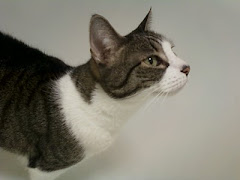
The Watcher Cat

The Watcher Cat

Saturday, May 31, 2014

The Comfort Kitty: 1999-2014

When la Caterina and I came together, she had four cats--Mama, Buster, Betty and Elvis. Mama died not so long afterward, but her kittens (actually 7 years old by that time) joined my cats (also around the same age, or a little younger) in the Brady Bunch of the cat world.

Elvis, pictured above (click to embiggen, as they say on the Intertubes), was the friendliest of the Catherine Collection. He and Giles worked out pretty quickly that Giles would be the Sheriff, and Elvis the diplomat. Elvis groomed all the other cats, and liked nothing better than snuggling with his people, or his fellow cats, or both.

We called him "the Comfort Kitty" because he had a sense for who was down, and would move his big, bulky, but inexpressibly soft presence, and snuggle for as long as you wanted. We used to joke that Elvis was like a gas--he expanded to fill all available space.

When we moved from Queens to Brooklyn, and Elvis acquired a set of stairs, he started getting more exercise, and lost a bit of weight. Good, we thought--because he was quite big. Nero Wolfe as a tuxedo cat, with a better disposition.

But a few weeks ago, he seemed to lose more weight. So we took him to the vet--just to be sure. The vet was concerned; she felt a mass in his abdomen that shouldn't be there. So we had an ultrasound done. In the time between appointments, he went from 13+ pounds to 12. He had a large tumor that could have been resected, we were told--but the lymph nodes were already affected. Under those circumstances, and in view of his age, we felt that surgery would be cruel.

The descent was unbelievably quick, though--from May 20 to today, he grew worse daily. As late as Thursday, though, he climbed into bed for a snuggle with me, as I lay doing proofs. This morning, though--we both knew.

The vet tech knew him, though his usual vet was off today, and we stayed with him till he was gone. I write these words having just returned home. The worst part about having pets is that we have to say goodbye so soon. But after eight years of love, I'd rather bear that wrench than deprive myself of the joy the Comfort Kitty brought to my life. And I know that he is gathered to his Maker.

Requiescat in pace, dear friend!

Friday, May 30, 2014

"Hyde" and Seek

Walter Kirn's review of Daniel Levine's new novel, Hyde came out just as I ran across the book at The Mysterious Bookshop, and certainly vindicates my decision to buy a copy:
Robert Louis Stevenson’s “The Strange Case of Dr. Jekyll and Mr. Hyde” is an oblique and artful Gothic tale framed as a detective story. The truth seeker is Jekyll’s lawyer, Utterson, the book’s most prominent character. Jekyll — the ­gentleman who dabbles in chemical self-­transformation — appears only ­intermittently, never fully speaking for himself until the end, when he discloses the details of the disastrous experiments that unleashed his primitive alter ego. The novel isn’t a conventional horror story, lingering on the macabre for its own sake, but an allegory of the divided self, perhaps also a meditation on addiction. Stevenson dramatizes human duality but doesn’t analyze its causes, treating it as pervasive and fundamental. For him, the Jekyll-Hyde split is the split in all of us, between the animals we evolved from and the angels we aspire to be.

“Hyde” is the first-time novelist Daniel Levine’s ingenious revision of this canonical work, an elevated exercise in fan fiction that complicates and reorients the story by telling it from the perspective of the monster, exposing the tender heart inside the brute and emphasizing the pathos of his predicament. Hyde is an outlet for Jekyll’s buried lusts, a manifestation of his banished id, but he is also a person in his own right who longs for acknowledgment and recognition. Far from being the accidental product of Jekyll’s experimental potion, he’s an integral, abiding second self who first emerged during Jekyll’s painful childhood as a defense against severe abuse and then went dormant inside him for decades, until the medicine reawakened him. While Stevenson casts Hyde as purely evil, a creature without a conscience, Levine — by placing him center stage and awarding him a full measure of humanity — portrays him as a wounded innocent, scorned, bewildered and oppressed. He dwells like a squatter in the body that he and Jekyll share, an illegal lodger, without rights.
An interesting notion, and I look forward to reading Levine's execution of the notion.

There's some overlap, certainly, with Steven Moffatt's remarkable sequel to Stevenson's work,Jekyll, in which the duality was always latent, and is a genetic feature of the original Jekyll/Hyde bloodline.

In Moffatt's telling, the modern day Tom Jackman and his alter ego--both superbly realized by actor James Nesbitt--come together when Jackman's wife and children--whom Hyde feels bonded too as well--are kidnapped by the shadowy project that seeks to exploit Hyde:


It's interesting how the Victorians won't let us rest, isn't it? The spate of Jane Austen sequels (and I do mean a spate, including eminent author P.D. James among the writers), should perhaps give Kirn pause is describing Levine's novel as "an elevated exercise in fan fiction"; but (not to go all Mandy Rice-Davies on you), I would say that, wouldn't I? After all, my own book, Phineas at Bay, could be described the same way. I think it's that we live in the world that the Victorians created, even now, and are only beginning to emerge from their long shadows. My maternal grandfather met Theodore Roosevelt, a High Victorian if ever there was one. He lived to see me graduate college, though not law school. So their world is not so far from ours, their stories the basis of many childhoods of those not yet old. And we find their stories resonate, as we face the implications of their choices, and the world they made.

But beyond my fellow-feeling for Levine, what looks interesting about his take is that it's not (like Moffatt's) a sequel that uses the time that has lapsed since the original to create complications, and explore the humanity of the monster, but rather makes the rather Trollopean point that everybody, even the villain, has his own point of view.

I look forward to reading Levine's novel, and wish him well with it.

The Never-ending Story

My editor and friend Karen Clark has a powerful,personal reaction to the misogynistic murder spree in Isla Vista a week ago. Others have explored the unrepentantly entitled, misogynistic community of which the killer was a part, and its continued embrace, or at least justification, of him even after the mayhem, and how that community may have shaped the killer.

I have--nothing. Just sorrow, for the the victims, their families, and a kind of weary disgust at the subculture that the killer and his defenders found themselves a home in. Oh, I've waited a week for some enlightenment, some shaft of something. It hasn't arrived. Except.

Except maybe this one isn't for me to opine on. I've been reading the burst of hard truths, prying open of hearts and minds and sometimes shocking statements on--of all things--Twitter: #YesAllWomen. Somehow the stream of tweets--not all of them; there's always the odd troll or two who has to butt in--seem hopeful to me, an avalanche of truths countering the blithe assumptions of what is normal that I get to make in my life but that women don't.

Maybe this is one for me to listen on, and to learn from others.

Monday, May 26, 2014

Memorial Day, 2014

My father's stepfather fought in World War II, and helped liberate a concentration camp. What he saw there clearly changed my "Uncle Fred"--so my sister and I called him, as he married my grandmother long after we came on the scene. He had an extraordinary gentleness, and an awareness of what mattered that I admired then and even more so now. But many who survived that trauma were marked differently than my Uncle Fred, and suffered for years after they come home, as do their successors.

From Herman Wouk's The Winds of War:
Victor Henry turned his face from the hideous sight to the indigo arch of the sky, where Venus and the brightest stars still burned: Sirius, Capella, Procyon, the old navigation aids. The familiar religious awe came over him, the sense of a Presence above this pitiful little earth. He could almost picture God the Father looking down with sad wonder at this mischief. In a world so rich and lovely, could his children find nothing better to do than to dig iron from the ground and work it into vast grotesque engines for blowing each other up? Yet this madness was the way of the world. He had given all his working years to it. Now he was about to risk his very life at it. Why?

Because the others did it, he thought. Because Abel’s next-door neighbor was Cain. Because with all its rotten spots, the United States of America was not only his homeland but the hope of the world. Because if America’s enemies dug up iron and made deadly engines of it, America had to do the same, and do it better, or die. Maybe the vicious circle would end with this first real world war. Maybe it would end with Christ’s second coming. Maybe it would never end.
In War and Remembrance, Wouk wrote (through the fictitious correspondent Alistair Tudsbury), that in World War II, "Men fight as far away from home as they can be transported, with courage and endurance that makes on proud of the human race, in horrible contrivances that make one ashamed of the human race." We seem mired in that paradigm still. Brave soldiers, women and men now, are taking terrible risks and paying prices up to including their lives. These veterans, under both Republican and Democratic presidents, receive woefully inadequate support and treatment.

Whatever we think of any given war, we should hold our veterans, living and dead, in high esteem. One last quote, from T.H. White, depicting a despairing King Arthur, written in the darkest days of WW II:
But here and there, oh so seldom, oh so rare, oh so glorious, there were those all the same who would face the rack, the executioner, and even utter extinction, in the cause of something greater than themselves. Truth, that strange thing, the jest of Pilate's. Many stupid young men had thought they were dying for it, and many would continue to die for it, perhaps for a thousand years. They did not have to be right about their truth, as Galileo was to be. It was enough that they, the few and martyred, should establish a greatness, a thing above the sum of all they ignorantly had.
Our veterans deserve better of us. Remember the fallen, and care for the living.

Sunday, May 25, 2014

Ch-Ch-Changes...


There is a lot going on. First, I am halfway through proofreading Phineas at Bay, despite serious damage done to the proofs by a cat who decided to do literally what some critics do figuratively over new authors. As the cat involved is not one of my more literary ones, however, I remain undaunted. I am indebted to CreateSpace for sending me a new set of proofs, without charge, even though the damage is solely due to my own carelessness in leaving the first set out where the critics, um, cats, could get at it. I join Philip Sandifer in his praise for the company--and let me strongly recommend his excellent site, combing superb analysis of Doctor Who with other cultural history-critical content.

Second, I have finished my second year of postulancy for the vocational diaconate, and will be entering my final term come September. More later of this.

More later also of the third development…

Finally, the site is being redesigned to reflect the increased literary/cultural content along with the content regarding Anglicanism, and my own development into the diaconate. There will still be law-related posts where relevant, or where I feel moved, but right now, the spiritual and the literary are where I am finding my greatest satisfaction, and that is where I plan to focus.

As ever, come along on the prowl!

In Memoriam, the Rt. Rev. E. Don Taylor

I am sorry to see that the Rt. Rev. E. Don Taylor has died, at 77 years of age.

From Bishop of New York, the Rt. Rev. Andrew Dietsche, per Canon K. Jeanne Person:
May 24, 2014

My dear brothers and sisters,

The Right Reverend E. Don Taylor, retired Vicar Bishop of the Diocese of New York, died this evening after an illness of several months. I am profoundly grateful for the number of clergy and people of this diocese who have surrounded him with their love through this vigil. Please pray tonight for the repose of his soul, and that God might comfort his daughter Tara in her grief. And please remember him at your altars tomorrow. Within twenty-four hours a fuller notice will come to you about the life and passing of this our dear brother and Father in Christ. May his soul, and the souls of all the departed, through the mercy of God, rest in peace.
-The Rt. Rev. Andrew M.L. Dietsche
Bishop Taylor received me into the Episcopal Church in 1995; I remember his brio, kindness and enthusiasm. I still have, and treasure, my little BCP, which he kindly inscribed for me.


I only knew him briefly, but he played a key role in my spiritual journey, and did so with élan, and genuine kindness. God bless his memory, and comfort his daughter Tara.

Thursday, May 22, 2014

The Joys of Live Theater

So, in proofreading, I need music, but not music that is too challenging or so engrossing that it pulls me out of the weird zen state--something a little frivolous, say. Pandora served up some interesting varieties, and that led me to discover this:


Yeah, the chorus-singer takes over the female lead for the ailing Barbara Dickson, and nails it.

The clip reminds me of something that happened to my old friend known on the blog as Athos. In the days before I came to Fordham, and Athos was an undergraduate, he was cast as Tranio in The Taming of the Shrew. Now, Tranio is the servant of Lucentio, and they open up the play-within-the-play, with Lucentio's monologue about why they are arriving in Padua in the first bloody place. Well, the production dropped the frame story, and just opened up with Lucentio and Tranio, who came out on stage.

On opening night, they made their entrance, and Lucnetio drifted moodily about the set, taking out his sword, swishing it about, but ….not saying the opening lines. After a few minutes, Athos prompted him, asking "Whyfor, my lord, fairest we to Padua?"

[Pause]

Lucentio: Oh, I don't know.

You or I, Gentle Reader, might have acted reasonably. Turned on our heel and left, say, or sung some Elizabethan ditty with a lot of hey-nonny-nonnies, and hoped to God that the blockhead would snap out of it. Not Athos. I am informed (and not by him) that what he did was this:

Trumio:
My lord, hastthou not oft expressed the great desire thou hadst
To see fair Padua, nursery of arts,
We are arrived for fruitful Lombardy,
The pleasant garden of great Italy;
And by thy father's love and leave are arm'd
With his good will and my good company,
thy trusty servant, well approved in all,
Here let us breathe and haply institute
A course of learning and ingenious studies.
Pisa renown'd for grave citizens
Gave thee thy being and thy father first,
A merchant of great traffic through the world,
Vincetino come of Bentivolii.
Vincetino's son brought up in Florence
It shall become to serve all hopes conceived,
To deck his fortune with his virtuous deeds:
And therefore, my lord, for the time you study,
Virtue and that part of philosophy
Will thou apply that treats of happiness
By virtue specially to be achieved.
Tell me thy mind; for thou hast Pisa left
And art to Padua come, as he that leaves
A shallow plash to plunge him in the deep
And with satiety seeks to quench his thirst.
A good save, no?

Alas, the next passage belonged to Tranio, so Athos continued:
And indeed, gentle master mine,
I am in all affected as yourself;
Glad that you thus continue your resolve
To suck the sweets of sweet philosophy.
Only, good master, while we do admire
This virtue and this moral discipline,
Let's be no stoics nor no stocks, I pray;
Or so devote to Aristotle's cheques
As Ovid be an outcast quite abjured:
Balk logic with acquaintance that you have
And practise rhetoric in your common talk;
Music and poesy use to quicken you;
The mathematics and the metaphysics,
Fall to them as you find your stomach serves you;
No profit grows where is no pleasure ta'en:
In brief, sir, study what you most affect.
If only Luecentio had not replied, "Well said!" and feinted an attack on on stage fern. But, alas, he did. Athos nobly went another round:
Perhaps, Master, we could at once put us in readiness,
And take a lodging fit to entertain
Such friends as time in Padua shall beget.
But stay a while: what company is this? Surely some show to welcome us to town.
Thereby winning the Karin Glenmark Award, some years before the lady herself created the title….